Orion (OEC)·Q4 2025 Earnings Summary
Orion Q4 2025: EBITDA Falls to Trough, But Free Cash Flow Positive; 2026 Guidance Below Street
February 17, 2026 · by Fintool AI Agent
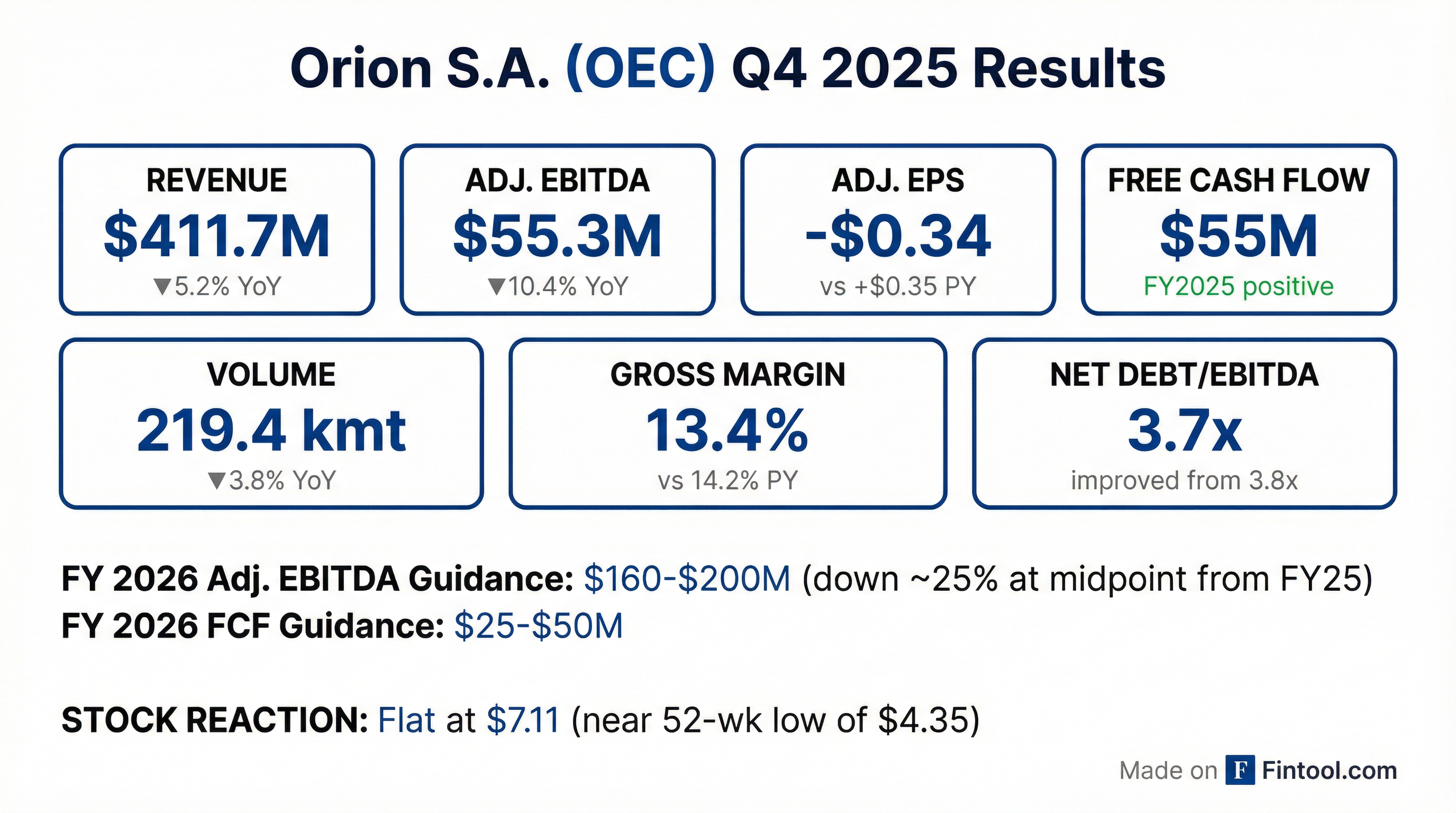
Orion S.A. (OEC) reported Q4 2025 results that marked a cyclical trough for the carbon black producer, with Adj. EBITDA falling to $55.3M—the lowest quarterly figure in over two years. However, management delivered on their free cash flow commitment, generating $55M for the full year versus guidance of $25-40M. The bigger story: 2026 guidance of $160-200M EBITDA represents a ~28% decline at midpoint from FY25, reflecting continued tire import headwinds and tough contract negotiations.
The call also introduced Jonathan Puckett as the new CFO, who joined Orion in December 2025 from Celanese where he served as VP and CFO of the Acetyl segment. He brings 30 years of financial leadership experience including 14 years in the chemical industry.
Did Orion Beat Q4 2025 Earnings?
Yes and no. While Q4 results reflected cyclical weakness, full-year 2025 EBITDA of $248M came in above management's October revised guidance range of $220-235M.
Full Year 2025: Revenue of $1.81B (-3.8% YoY), Adj. EBITDA of $248M (-18% YoY), and Adj. EPS of $0.50 (-$1.26 YoY).
 Ask Fintool AI Agent
What Did Management Guide for 2026?
Management issued 2026 guidance well below 2025 levels, reflecting ongoing tire import challenges and difficult contract negotiations:
The guidance notably does not assume a freight market recovery or improvement from current conditions. The significant capex reduction signals management's defensive posture.
What's Driving the Weakness?
Tire Imports: The Core Problem
The fundamental issue remains elevated tire imports into Western markets, which have suppressed domestic tire production—Orion's core demand driver:
- U.S. tire production down ~29% vs. normalized levels
- Western Europe production down 35%
- Tire imports surged to record levels in 2025, with tariff uncertainty magnifying the surge
- Consumers traded down to Tier 3/4 brands (imports), especially smaller fleet operators in truck/bus
Encouraging Signs: Tier 2 and Tier 1 tires outsold Tier 3 brands for the first time in 2025—a reversion to historical consumer preferences that benefits Orion's customers.
Freight Market: A Hidden Headwind
A often-overlooked factor: Truck and bus tires account for ~1/3 of global carbon black consumption and over 40% in the Americas. The freight recession has been a significant drag:
- Cass Freight Shipment Index shows 3 straight years of declining freight activity
- 2025 freight levels fell below 2020 pandemic lows
- Spot freight rates rebounding—potential inflection indicator
Segment Performance
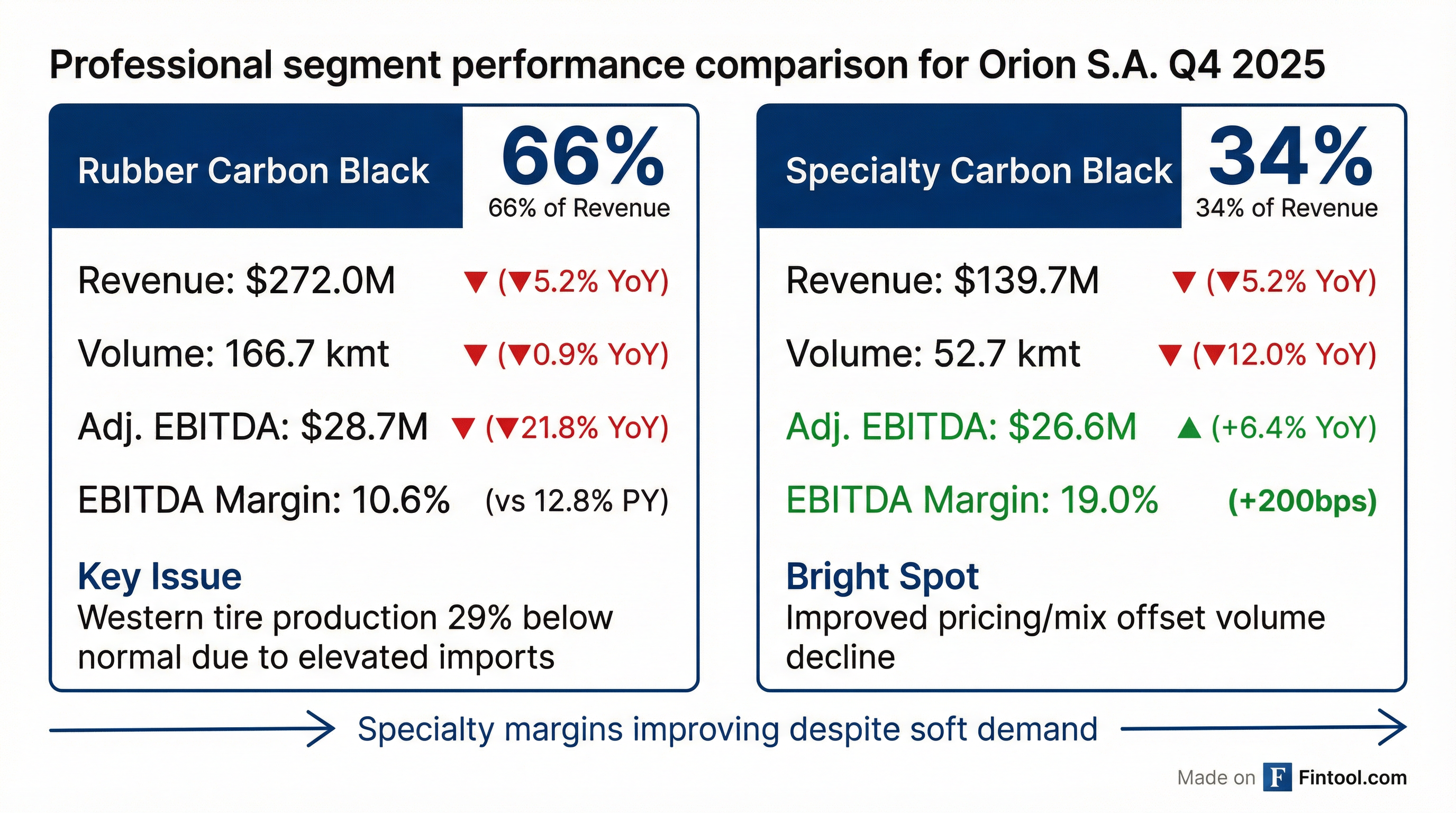
Rubber Carbon Black (66% of revenue): The larger segment bore the brunt of weak demand. Q4 2025 Adj. EBITDA of $28.7M was down 22% YoY, with volumes just down 1% but margin compression from unfavorable regional mix.
Specialty Carbon Black (34% of revenue): A relative bright spot with Q4 EBITDA up 6% YoY to $26.6M despite 12% lower volumes, driven by favorable price/mix and co-generation contributions. Margins expanded to 19.0% from 17.0%.
What Self-Help Actions Is Orion Taking?
Management outlined several initiatives to navigate the trough:
- Cost savings of ~$20M in 2026 from productivity, efficiency, and headcount reductions
- Footprint rationalization — closed 3-5 production lines (Americas and EMEA)
- Manufacturing excellence — N.A. plant reliability improved 200+ basis points in 2025, driving "markedly improved" on-time delivery
- Lower capex (~$90M in 2026 vs. $161M in 2025)
- Credit agreement amended with unanimous bank support, providing leverage headroom even in scenarios worse than guidance
- AI and process technology — deploying "capital-light but novel process technologies" including at least one AI tool for greater process efficiency
Strategic Pivot: Management shifted from trading off volume for price to a "win with our customer" strategy to maintain share. CEO Painter noted that customers facing weak demand sought to consolidate suppliers, which "favored global suppliers like Orion." The company emerged having "defended our overall share and gotten closer to a few of our key customers."
Safety & ESG: 2025 was Orion's second-best safety year since going public with only 3 incidents globally—about 9x better than the broader chemicals industry. Just yesterday, EcoVadis awarded Orion its platinum rating, placing them in the top 1% of all companies surveyed in 2025.
Ask Fintool AI AgentWhat Are the Potential Upsides?
Management highlighted two scenarios not reflected in guidance:
1. Shifting Global Trade Flows
- Thailand (largest U.S. tire exporter) exports declining since August framework for country-specific trade deal
- India (major OTR producer) exports have reduced sharply
- Section 232 tariffs on truck parts (including tires) effective November 1, 2025
- EU anti-dumping investigation on Chinese tires expected to conclude in June; simultaneously launched probe into subsidies
- Reshoring benefits dependable local suppliers like Orion
2. Freight Market Recovery
- Freight activity in 2025 dropped below 2020 levels
- Spot freight rates rebounding—suggests potential inflection
- Not assumed in guidance
N.A. Tire Production Capacity Growth
Net growth of 47 million tires/year in North American production capacity expected from 2025-2030 (~3% CAGR), with billions in announced investments from major tire companies.
What Did Analysts Ask About? (Q&A Highlights)
On Pricing Negotiations (Josh Spector, UBS): Management clarified they did not "buy" volume through aggressive price cuts. CEO Corning Painter: "We pivoted to just let's hold share... compared to previous years, we're not gonna be down more than the overall industry. We did not do the trade-off of sucking up a lot of volume loss ourselves." Painter expects to recoup some pricing in 2027 if conditions improve.
On Pricing vs. Cabot (Jeff Zekauskas, JP Morgan): When asked about Cabot's 7-9% price decline, Orion indicated their price cuts are in the 3-5% range, though management cautioned direct comparisons are difficult due to differences in how companies calculate the metric.
On Contract Structure (John Tanwanteng, CJS): Contracts include financial incentives around volume minimums rather than strict take-or-pay provisions. Capacity under contract is "slightly lower" than normal, reflecting tire manufacturers' forecasts based on depressed second-half run rates.
On La Porte Conductive Carbons Plant (Jeff Zekauskas, JP Morgan): The project timeline has been pushed out to 2027 for startup (previously expected earlier), better aligning with end market demand given EV slowdowns and ESS growth. Expected to add ~$10M in annual depreciation. Startup costs will be primarily in 2027, not 2026.
On Working Capital Sustainability (Jeff Zekauskas, JP Morgan): Accounts payable jumped to $197M in Q4. Management confirmed this is sustainable through negotiated terms extensions and will not immediately reverse. The company is actively managing all working capital levers (AR, inventory, AP) holistically.
On Plant Closures (John Roberts, Mizuho): The 3-5 production lines closed were located in the Americas and EMEA. Management declined to provide specific locations for competitive reasons but confirmed all intended closures are complete.
How Did the Stock React?
OEC shares were flat at $7.11 following the release, trading near the 52-week low of $4.35. The stock is down 57% from its 52-week high of $16.63.*
*Values retrieved from S&P Global
Balance Sheet & Cash Flow
Despite the earnings decline, Orion maintained financial discipline:
The February 2026 credit agreement amendment ensures covenant headroom while navigating the business cycle trough.
What Changed From Last Quarter?
Q4 included typical seasonal weakness plus customer inventory drawdowns, but was not as severe as initially indicated by customers.
Forward Catalysts to Watch
- USMCA trade agreement reset (effective July 1, 2026) — Canada and Mexico are net tire exporters to U.S.
- EU anti-dumping investigation findings on Chinese tire exports
- Contract negotiations completion — still behind typical timeline
- Freight market inflection — any recovery would be upside to guidance
- N.A. tire plant capacity additions coming online through 2030
Ask Fintool AI AgentKey Takeaways
- Cyclical trough confirmed: Q4 EBITDA of $55.3M marks the lowest point in 2+ years
- Cash flow positive: FY25 FCF of $55M beat guidance, validating management's self-help efforts
- 2026 guidance sobering: $160-200M EBITDA midpoint ~28% below FY25, no recovery assumed
- Specialty resilient: Margins expanding to 19% despite volume declines
- Balance sheet intact: Net debt down, leverage improved, credit agreement provides headroom
- Pricing defended: 3-5% price cuts vs Cabot's 7-9%; share maintained with "win with customer" strategy
- La Porte delayed: Conductive carbons plant pushed to 2027 startup; costs/depreciation shift to 2027
- Upside not in guide: Trade flow shifts and freight recovery could drive material upside
Data as of February 17, 2026. Financial data from company filings and S&P Global.
Related Links: